AUF2 urges decisive action on African urban resilience and housing
Urban resilience is becoming a development priority for Africa, and secure, adequate housing is key to building resilient cities and communities. The time for action to address the continent’s housing crisis, and thus drive urban resilience, is now.

This was the clarion call of the second Africa Urban Forum (AUF2), hosted by the Government of Kenya in Nairobi between 8 and 10 April 2026. A continental platform of the African Union Commission (AUC), AUF2 brought together heads of state, policymakers, local governments, development partners, private sector actors and civil society to address the opportunities and challenges posed by Africa’s rapid urbanisation, at the fastest rate in the world. Technical support to the convening was provided by the United Nations Human Settlements Programme (UN-Habitat) and the United Nations Economic Commission for Africa (UNECA).
AUF2 resulted in the Nairobi Declaration, a landmark statement committing Africa to tackling the continent’s immense housing crisis and harnessing rapid urbanisation as a primary driver for economic growth and sustainable development.
AUC Commissioner for Agriculture, Rural Development, Blue Economy and Sustainable Environment, HE Moses Vilakati, speaking on behalf of the AUC’s Chairperson HE Mahmoud Ali Youssouf, said housing is central to Africa achieving the AU’s Agenda 2063 development goals: a matter of dignity and human rights, it is essential for economic productivity, social stability and peace, and – also importantly – it is central to sustainable and inclusive development.
“It is our collective responsibility, therefore, to take stock of the progress that has been made by African Union Regional Economic Communities, our national governments and local communities in implementing the commitments that were adopted during the inaugural African Urban Forum in 2024. We must now accelerate our efforts to translate these commitments into concrete actions,” he concluded.

‘Urban Resilience in Africa’ report launch
An important moment at the AUF2 was the formal launch of Urban Resilience in Africa: A Continental Review, a seminal AUC-led report that establishes a baseline on urban resilience across all regions in Africa. This groundbreaking document was formally launched in the AUF 2 opening session on 8 April by HE Dr. William Ruto President of the Republic of Kenya, HE Mr. Moses Vilakati, Commissioner for ARBE, AUC and HE Ms. Anacláudia Rossbach, Executive Director of UN-Habitat.
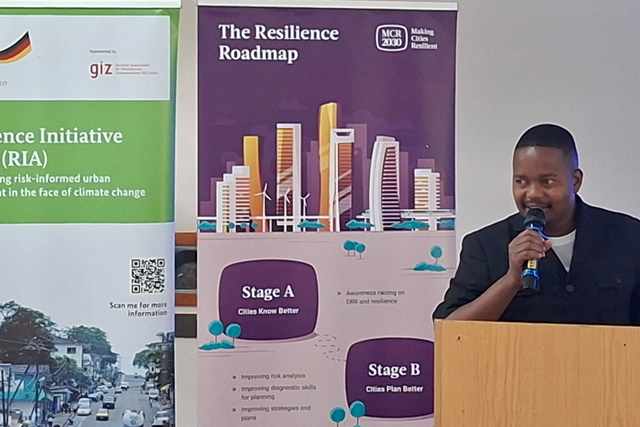
The AUC, under the Africa Urban Resilience Programme (AURP) developed the report with support from the Government of Germany through Deutsche Gesellschaft für Internationale Zusammenarbeit (GIZ) GmbH’s Resilience Initiative Africa (RIA), in collaboration with the Aqinile Partnership (UNDP, UN-Habitat, AUC) and the United Nations University – Institute for Environment and Human Security. The report investigates the state of urban resilience in Africa, as well as gaps and opportunities for the sustainable development of urban areas. It covers 50 urban areas, complemented by case studies in five cities, and provides a robust evidence base for guiding policy, investment and multi-level governance reform.
The report’s findings show that while momentum for resilience is growing, African urban areas face systemic constraints in governance, financing, service provision and climate readiness. However, the continent also demonstrates ingenuity, community-driven innovation and rapidly evolving institutional practices, which can be scaled through coherent policy action.
“For me, the Africa Urban Forum reinforced a simple but important point: resilience is built through partnerships. As the German Development Cooperation, our ambition is to connect strategy with implementation – working with cities, institutions and communities to ensure that resilience is not just discussed but delivered,” says GIZ RIA’s Head of Project, Ria Hidajat.
“What struck me at the Africa Urban Forum is how strong the momentum for urban resilience has become. But momentum alone is not enough, as it now requires leadership to translate ambition into sustained action at city level, where risks and realities are most immediate.”
Resilience Through Our Eyes initiative
A striking visual representation of the issues of urban resilience came in the form of another RIA activity, called Resilience Through Our Eyes. This photographic project involved young adults from urban settlements across Africa being provided with cameras and training and then challenged to tell visual stories of resilience in their communities. The best images were then selected for exhibition at the AUF2 at the joint AUC and GIZ RIA exhibition booth.
The exhibition made an impact on both delegates and the photographers, who were in attendance at the forum. One youth photographer, Rosemary Natasha Kabosha from Zambia, says: “My experience working on the Resilience Through Our Eyes project has been amazing. Along the way, I made mistakes, got corrected and faced challenges, but each experience helped me learn and grow.”
“I was happy to share my work with different people at the Africa Urban Forum in Kenya and see how people connected with and learned from my story. It also inspired me to continue using storytelling to share community experiences and resilience stories.”

More RIA contributions at the AUF2
Apart from the AUC report launch and the photo exhibition, RIA made several more important contributions at the AUF2. These include:
- Co-leading a high-level ministerial session on resilience building and sustainable urban development in which the Urban Resilience in Africa: A Continental Review report was showcased by Germany’s Deputy Ambassador to Kenya, Alexander Fierley.
- In collaboration with the AUC and UNDP, leading a side event on integrating multi-level early warning and early action systems in urban centres to reduce disaster losses.
- In partnership with the GIZ CIVIC Platform, hosted a side event on climate-proofing the build environment and co-organizing a second side event on financing climate-resilient urban infrastructure for adequate housing.
- Contribution in a side event on integrating disaster resilience in urban planning and infrastructure development in African cities.
- Contribution in a side event on advancing water security and sanitation for Africa’s cities. GIZ RIA’s Head of Project Ria Hidajat was a panellist in this event.
A vital AUF2 commitment: the Nairobi Declaration
A key outcome of AUF2 is the Nairobi Declaration, which outlines a joint commitment to accelerating sustainable urbanisation, formalising housing and bridging Africa’s infrastructure gap by 2035. Relevant to the Africa Urban Resilience Programme (AURP) that is supported by RIA, the declaration emphasises climate-resilient development and the strategic role of African cities in global climate action.
Core components of the Nairobi Declaration include:
- Infrastructure and resilience: it highlights the need to formalise settlements, invest in sustainable infrastructure and improve urban resilience to climate change.
- Housing as a driver: it positions adequate housing as a social imperative and an economic engine for structural transformation.
- Implementation focus: it calls for a transition from dialogue to action, aiming to halve Africa’s housing deficit by 2035.
- Empowering local government: it recommends empowering subnational governments to handle land use planning and fiscal capacity for bankable projects.
- Finance and innovation: it promotes innovative financing, including private sector resource mobilisation, and using digital technologies for urban planning.
- Continental agenda: it aligns with the AU’s Agenda 2063, the UN’s New Urban Agenda and the UN Sustainable Development Goals.
The Nairobi Declaration commits AU Member States to taking decisive action to address Africa’s housing crisis, through establishing a comprehensive strategy with several key priorities. Politically, it calls for housing to be prioritised in all national development plans and endorses a new Africa Affordable Housing Compact to unite governments, the private sector and financial institutions. It also commits to critical financial reforms aimed at empowering cities, and calls for land reforms to provide secure tenure, especially for those in informal settlements.
With a strong focus on climate change, the declaration calls for the urban focus of all national climate commitments to be strengthened. Crucially, it also includes a robust framework for accountability, committing Member States to harmonised continental monitoring and a scorecard-style reporting system to ensure that ambitious goals are tracked and achieved.